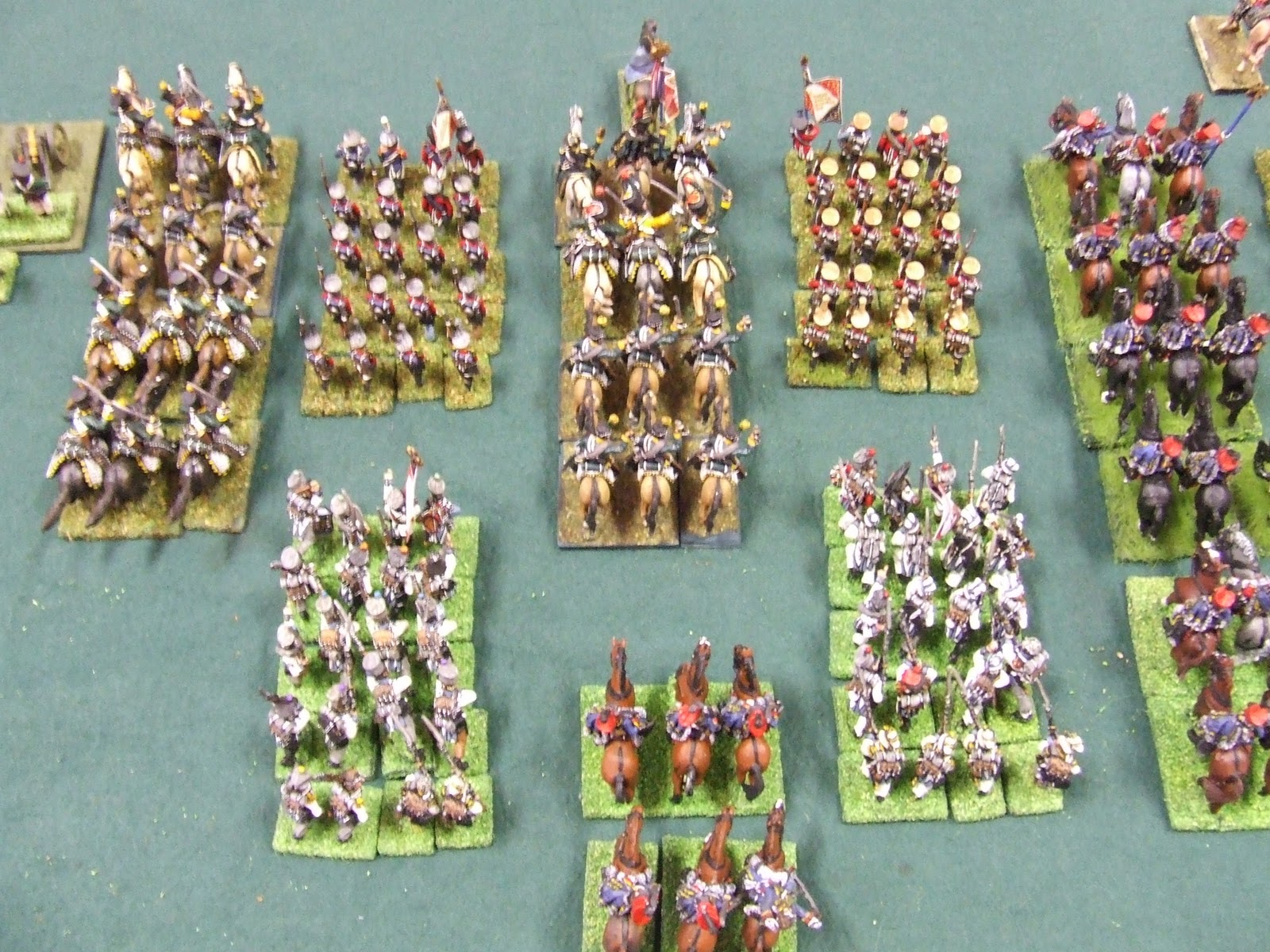
The Peninsula 1812
The troops involved are all those owned by the players when the campaign starts as well as any new formations during the campaign (these new ones will start at their respective headquarters.
I will be the Umpire and my growing Westphalian Corps is in the campaign plus some Brunswick Hussars and some Portuguese infantry, my pontoon train will become Westphalian (this will be a shock to the Allied commander).
See below.
The Peninsula
Campaign 1812
The Earl of Wellington (Wellesley) started 1812 with the capture of Ciudad Rodrigo on January 19-20 1812 (unfortunately the army sacked the city).
Wellington
At
the beginning of March 1812 Wellington moved
quickly against Badajoz Guadiana
River Badajoz started on the 17th March, Generals
Hill, Graham and Villemur were out entertaining and dancing with d’Erlon and
Soult, leaving Wellington in peace to take Badajoz
Soult’s
advance for the relief of Badajoz Wellington
now controlled all the fortress (Spanish and Portuguese) covering the main
invasion routes into Portugal
from Spain and vis-à-vis, this
also secured Wellington
Now
Wellington could advance into Spain and take on the Army of Portugal on his (Wellington
Paul B - King ofSpain and C-in-C – At Madrid
Roy - French Army of the Centre- HQ Madrid
Robert - French Army of Portugal-HQValladolid
Michael- French Army of the South-HQ Sevilla
Don - British C-in-C Anglo-Portuguese Army & Spanish Armies-HQ Almeida
Jason - British General Hill-HQBadajoz
Paul C - British General Graham-HQ
Andrew- Spanish 1st Army attached to Wellington-HQ
David - Spanish 4th Army, in the Centre-HQ Chinchilla
Bryan - Spanish 2nd Army, in the South-HQ Cordova
Map
FromOman
Please have printed in A3 colour and laminated.
Supply
Formation Sizes
Tabletop Rules
This may not be to the satisfaction of everyone but there are a number of views on which are the best rules, and that will not change, we have to agree to disagree here. My compromise is using two sets of rules one everyone is familiar with and the other will become familiar or more familiar (depending how much you have played them already) with over time, but given the more limited scope of this campaign rule set number two may not be used that often.
There will be objectives on the tabletop there will also be event cards some good some not so good this depends on which side you are on at the time the card is played.
1) WRG for up too about a corps size force (with the required NSWC amendments).
2) Blackpowder for multiple corps (on at least one side) size forces, possibly with some amendments.
3) The troops will use the WRG point system.
4) We will included a force break point system where by the number of dead and routing units starts to get to high the commander will have to throw a die to see if his force breaks (this will mean that all routing units can not be rallied and more difficult for the remainder of the army to not rout).
5) There will be a 50% rule whereby when a unit reaches less than 50% of it’s starting strength (at beginning of the battle) it is unsteady and will rout if it fails any morale test.
6) For battlefield victory conditions where there is the ABP (Army Break Point-this does not mean the army will rout it will be harder for formations to stand) the ABP is also based upon the overall morale rating of the formation (easier to reach ABP for Raw than Veteran formations. The battlefield objective will have a points value system, this will help determine victor and defeated. I say help in establishing winner and loser as there may be a situation where side ‘A’ has lost more, troops than side ‘B’ but could still be the victor because they achieved their battlefield goal which maybe physical on the field as well as tactical within the campaign.
7) Battlefield commanders will write a general order for the game, objective/s etc. This order cannot be to general in aspect.
8) All Line troops will start off as Raw/Green, All Guard troops (Except French Old Guard and British Guard) will start off as Veteran, the French Old Guard and British Guard will start as Elite. WRG rules do not prohibit Unsteady/Raw troops from charging but NSWC amendments do (a unit must be steady/rallied to initiate a charge) but for this campaign all troops that are classed as Raw because they are yet to have an experience defining battle can charge (but remember they are Raw).
9) The Raw troops will fight 1 action as Raw and become trained from the 2nd action, then the trained become Veteran from their 4th action (the Umpire, see CMG, will let you know). Spanish will add one action, so 2nd becomes 3rd (this does not include the Spanish 1st Army under British direct control).
10) The Veteran Guard will fight 2 actions as Veteran and become Elite from the 3rd action (for Spanish see above). The Elite (French Old Guard and British Guard) fight 2 actions as elite and then become Elite Veteran from the 3rd action.
11) The Umpire will produce the Orbats and email them to the players.
12) All Orders after the first General Orders (issued by the C-in-C’s) will be emailed to the Umpire as an attached Word document (examples will be sent). The Umpire will then send to the receiver player at the appropriate campaign date.
This is the list of formations and their
respective HQs’Paul B - King of
Roy - French Army of the Centre- HQ Madrid
Robert - French Army of Portugal-HQ
Michael- French Army of the South-HQ Sevilla
Don - British C-in-C Anglo-Portuguese Army & Spanish Armies-HQ Almeida
Jason - British General Hill-HQ
Paul C - British General Graham-HQ
Andrew- Spanish 1st Army attached to Wellington-HQ
David - Spanish 4th Army, in the Centre-HQ Chinchilla
Bryan - Spanish 2nd Army, in the South-HQ Cordova
Map
From
Please have printed in A3 colour and laminated.
Supply
Formation Sizes
Tabletop Rules
This may not be to the satisfaction of everyone but there are a number of views on which are the best rules, and that will not change, we have to agree to disagree here. My compromise is using two sets of rules one everyone is familiar with and the other will become familiar or more familiar (depending how much you have played them already) with over time, but given the more limited scope of this campaign rule set number two may not be used that often.
There will be objectives on the tabletop there will also be event cards some good some not so good this depends on which side you are on at the time the card is played.
1) WRG for up too about a corps size force (with the required NSWC amendments).
2) Blackpowder for multiple corps (on at least one side) size forces, possibly with some amendments.
3) The troops will use the WRG point system.
4) We will included a force break point system where by the number of dead and routing units starts to get to high the commander will have to throw a die to see if his force breaks (this will mean that all routing units can not be rallied and more difficult for the remainder of the army to not rout).
5) There will be a 50% rule whereby when a unit reaches less than 50% of it’s starting strength (at beginning of the battle) it is unsteady and will rout if it fails any morale test.
6) For battlefield victory conditions where there is the ABP (Army Break Point-this does not mean the army will rout it will be harder for formations to stand) the ABP is also based upon the overall morale rating of the formation (easier to reach ABP for Raw than Veteran formations. The battlefield objective will have a points value system, this will help determine victor and defeated. I say help in establishing winner and loser as there may be a situation where side ‘A’ has lost more, troops than side ‘B’ but could still be the victor because they achieved their battlefield goal which maybe physical on the field as well as tactical within the campaign.
7) Battlefield commanders will write a general order for the game, objective/s etc. This order cannot be to general in aspect.
8) All Line troops will start off as Raw/Green, All Guard troops (Except French Old Guard and British Guard) will start off as Veteran, the French Old Guard and British Guard will start as Elite. WRG rules do not prohibit Unsteady/Raw troops from charging but NSWC amendments do (a unit must be steady/rallied to initiate a charge) but for this campaign all troops that are classed as Raw because they are yet to have an experience defining battle can charge (but remember they are Raw).
9) The Raw troops will fight 1 action as Raw and become trained from the 2nd action, then the trained become Veteran from their 4th action (the Umpire, see CMG, will let you know). Spanish will add one action, so 2nd becomes 3rd (this does not include the Spanish 1st Army under British direct control).
10) The Veteran Guard will fight 2 actions as Veteran and become Elite from the 3rd action (for Spanish see above). The Elite (French Old Guard and British Guard) fight 2 actions as elite and then become Elite Veteran from the 3rd action.
11) The Umpire will produce the Orbats and email them to the players.
12) All Orders after the first General Orders (issued by the C-in-C’s) will be emailed to the Umpire as an attached Word document (examples will be sent). The Umpire will then send to the receiver player at the appropriate campaign date.

On the Map.
Dark red roads are the main roads can support a corps size
force all the time, multiple corps for about 4-6 days.
Green dot roads are the secondary, can support a reinforced
division all the time and a corps for about 4 – 6 days.
Main Rivers are in Dark Blue, secondary rivers are black and
treated as streams on tabletop.
Rivers can only be crossed by bridge where a road crosses
the river.
Capital cities in Red and Towns are marked.
Guns: A couple of
players are already moving to having their guns glued on bases with the crew
also glued to the base, it is therefore decided that all guns have 4 crew with
no less than two crew figures glued on a gun base (players can still use four
figures per gun), die to be used to indicate crew losses and to save having
dice against each gun a gun base is removed once 4 crew have been lost to the
battery/company (this will also apply to those players that do not have guns
and crew glued to the base). If the battery routs we turn the guns (this to see
if the guns are captured or not by the end of the day) around and all crew are
assumed to have routed off table.
An infantry brigade is 3-6 battalions
An infantry division is 2-3 brigades
A cavalry brigade is 2-3 regiments
A cavalry division is 2-3 brigades
A corps 2-3 infantry & 1-2 cavalry divisions (you may
want to decrease infantry and increase cavalry, so you can mix it about, that
is why the range)
An army, two or more corps, these can concentrate for no
more than 4 days for supply reasons for the French and up to six days for
Anglo-Portuguese in Portugal and 4 in Spain (Spanish stole from everyone).
A reinforced infantry division 2-3 infantry brigades & a
cavalry brigade.
March Rates
20 miles a day for infantry and foot artillery (20mm on an
A3 map)
30 miles a day for cavalry & horse artillery (30mm on an
A3 map)
10 miles a day for transport & siege trains. (10mm on an
A3 map)
Formations will be moved at the speed of the slowest unless
stated otherwise.
Watch this space for updates. I do not tend to place new posts every-time I tend to up date the post when needed.