Showing posts with label Massena. Show all posts

Saturday, May 10, 2014

1806 Neapolitan Campaign

1806 Neapolitan Campaign


On 9 February 1806, Marshal Masséna as commander of the French Army of Italy (well Joseph Bonaparte was nominal commander, the pattern is set here that would later happen in Spain) invaded the Kingdom of Naples.

King Ferdinand IV of the Kingdom of the Two Sicilies had promised to be neutral during the war of the Third Coalition, thus securing Napoleon’s southern flank and his Italian Kingdom.
During the campaign in Germany Napoleon learned of the British and Russians landing troops in the Neapolitan kingdom, thus breaking the kingdoms neutrality (even though Ferdinand confused his blamelessness).

So we start our campaign at this point with the French making the first move on the 9th February 1806 (winter).

The French have three corps I, II and IV Corps (with French and Italian troops) of the Army of Italy with two I & IV in Rome and II Corps in Ancona (however because Ancona does not appear on the map we are using this corps will start at Fermo on the 11th February).

As for the Allies there is the Neapolitan Army (they favour building prepared positions like the Russians) both it’s regulars and militia and well as the British and Russians, there has also been added an Austrian Division (the commander has not received the news of the signing of the Treaty of Pressburg on the 26th December and does not believe the French when they sent the news), so he will fight, for now.

The British and Neapolitans start at Fondi on the west coast (the main theater) on the road from Rome via Terracina via Capua to Naples.

The Russians and Neapolitans are at Pescara on the east coast, with the Austrians with Russian support at Aquila.

The Allies seek to keep the French from over running the Kingdom of the Two Sicilies both the mainland part (Kingdom of Naples) and island part (Kingdom of Sicily).

The French of course want all of both kingdoms as the new Kingdom of Naples for Joseph Bonaparte as King.

The French objectives are on the west coast as follows:

Gaeta Fortress, either capture or blockade.
Capua,
Naples,
Cosenza,
Reggio
And the destruction of the Allied forces.

The French objectives are on the east coast as follows:

Pescara,
Foggia,
Bari,
Brindisi,
Otranto
And the destruction of the Allied forces.

The Allied objectives are to hold the above mention French objectives and the halting and or destruction of the French forces and as a consequence being a threat to the Napoleonic Kingdom of Italy.

The rules we are using for this campaign are Blackpowder.
The average size infantry units will be 16-24 (4-6 bases) figures
Small is under 16 (4) and Large over 24 (6) figures.
The average cavalry units will be 9-18 figures.
Small is under 9 and Large is over 18 figures.
Batteries are under BP a single gun & crew.
What we will have is 1 gun & crew represent 6 gun batteries
2 guns & crew represent 8 gun batteries
3 guns & crew represent sent 12 & 14 gun batteries.

There will be Victory Points (VP) for battle field objectives as well as for units removed from the field by shooting or hand-to-hand but not for shaken units.
The event cards will also be used.

There are only two players doing the map moves
French  - Robert
Allied    - Steve M

Infantry move at 10 miles per day max
Cavalry move at 20 miles per day max
Couriers move at 40 miles per day max
 These movement rates will be halved in bad weather.

While French units will be represent by French figures
Italian units by Italian where we can and Westphalian to make up when needed.
British units by British figures.
Russian units by Russian figures.
Austrian units by Austrian figures.
Neapolitan units by Spanish & Austrian figures (as this army modeled it’s uniforms after Austria and Spain).

This campaign should not be over long.

The first battle took place at the club on the 18th May 2014.
Campaign time 15th February 1806.

Umpire

There have four battles so far with the French winning the first three battles and tactical draw on the fourth.
The next game will take place at Salerno for the February 2015 game day.

Battle of Fondi


Battle of Santi


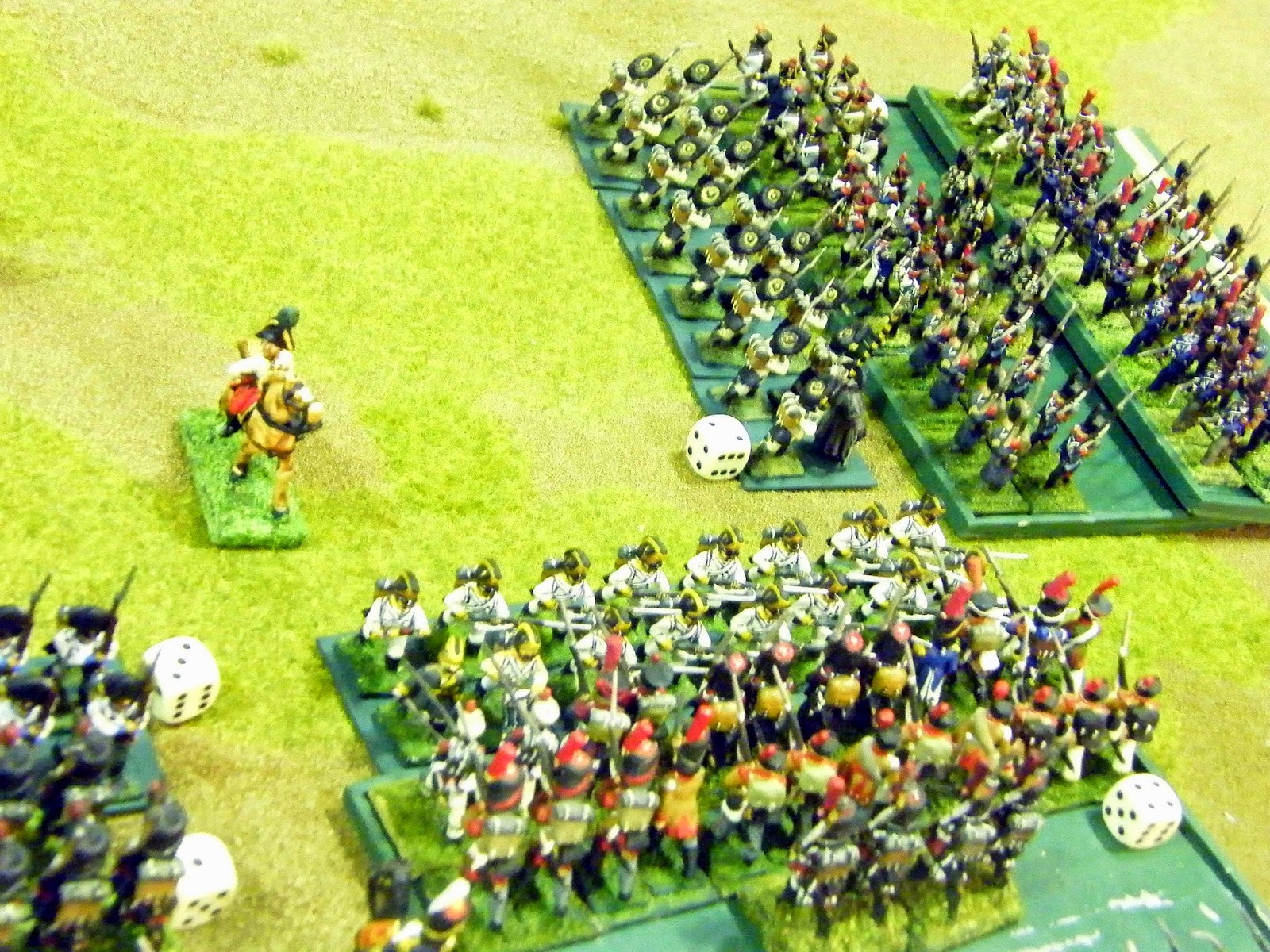
Austrian infantry charging French Grenadiers on the Allied right flank

Battle of Pescara


Friday, January 13, 2012

NSWC Campaigns-1809

THE 1809 PENINSULAR CAMPAIGN

This campaign was being played in 25mm using WRG rules with a few modifications for simultaneous movement.

For the French, British and Portuguese armies the only forces involved are those owned by the players, as for the Spanish it is based on the forces available to the Spanish at the time with a little artistic licence. Don McIntyre is at the moment providing the bulk of the Spanish units with a growing number coming from Robert Horspool (as I paint more of his Front Rank units so more will be his). Any extra units painted by any player or for any player arrive in a reinforcement town and are then marched to their command.

We started the campaign as of 1 May 1809 with the French controlling Northern Portugal, Northern Spain, and Central Spain (we have ignored Eastern Spain). The Anglo-Portuguese under Sir Arthur Wellesley controls all Portugal south of the Douro and the fortress of Almeida and Elvas. The Spanish control Southern Spain and also have an Army in the North-West and have the fortresses of Cuidad Rodrigo and Badajoz.

The campaign opened with an advance by the Anglo-Portuguese army against the French in Northern Portugal, this resulted in a number of small actions at Amarante 8th May 1809 (British Victory) and Villa Real 12 May 1809 (French Victory) and at least two major battles at Oporto 12 May 1809 (British Victory) and Vila de Ledra 17 May 1809 (French Victory). The result was that the French VII and VIII Corps of the Army of Portugal have been forced to leave Portugal, which allows the Anglo-Portuguese to move against the French forces laying siege to Cuidad Rodrigo.
Spanish Ferdinand VII Horse Grenadiers

Meanwhile the Spanish Army of Estremadura, with the support of the British 4th Division advanced on the French II Corps at Merida (French Victory) fighting a battle on the 15th May 1809. The Spanish Army of La Mancha advanced to Toledo in order to move onto Madrid however, this army was stopped by the French I Corps at Almonacid de Toledo on the 22nd May 1809 (French Victory). The Spanish Army of Galicia advanced from Leon towards Valladolid to cut the French main supply route, the French Army of the North concentrated and fought the Spanish at Medina de Rio Seco on the 25th May 1809 (French Victory).

On the 28th May 1809 the Army of Portugal managed to make one breech in the walls of Ciudad Rodrigo.  Marshal Massena decided to attempt a storming of the breech.  The storming was assigned to two brigades of the IV Corps with support of a third brigade and the corps field artillery plus two batteries of siege artillery.   After 4 hours of fighting the Spanish governor decided to withdraw from the main walls and then to leave Cuidad Rodrigo.  As the IV Corps only had one brigade left attempting to watch the remainder of the fortress walls, the Spanish managed to slip out of the fortress to the south on an unguarded road.  In the end the Army of Portugal had taken one of the two fortresses it needed to captured in order to invade Northern Portugal.

Sir Arthur Wellesley after hearing the besieging guns fall silent and then receive word that Ciudad Rodrigo had fallen decided to advance from Guarda to the lost fortress.  In the process of his advance the Anglo-Portuguese Reserve Corps under Beresford forced the French watching the Guarda road to withdraw beyond Ciudad Rodrigo (after placing a garrison in the town and quickly filling at least half of the trenches and battery positions and partly repairing the breech.  This French withdrawal from the Guarda road also forced the withdrawal of the forces watching the Almedia road or they could have been cut off by the English.

Marshal Massena assembled his army and advanced towards Sir Arthur.   This advance forced Sir Arthur to withdraw from Ciudad Rodrigo and take up a position at Fuentes d'Onoro.  Massena advanced to Fuentes d'Onoro and attacked the British on the 6th June 1809.  Two divisions of French cavalry and one and half divisions of infantry supported by most of the artillery attacked Fuentes d'Onoro which was being defended by the Light Division and with 7th Division in support to the right.   Three French cavalry divisions & one and half infantry divisions advanced on the British centre being held by Picton's 3rd Division, the British cavalry and Portuguese Loyal Lusitanian Legion, these forces where behind the ridge crest with only their artillery forward.  On the French right the Marshal sent one division of cavalry and the remaining one and half divisions on a small front against a Spanish division.   The Anglo-Portuguese-Spanish forces were beaten and forced to retreat towards Viseu.

Also on the 6th June General Hill with the 1st Corps gave battle to the French at Benevente and lost.  The 1st Corps moved south via Mirandela, Rinhovelo and Espinho to Almeida, attacking the French beseiging the fortress on the 19th June.  This battle resulted in another defeat for General Hill with the loss of almost all his corps artillery.  The 1st Corps retreated to Pinhao and rested.   The 1st Corps adavnced towwards Almeida again on the 24th June and arrived on the 27th June finding the French had failed to take the fortress and had been forced to retreat by the advances of Sir Arthur and the Reserve Corps.  The Reserve Corps caught the French in its withdrawal from Almeida at Aldea del Obispo inflicting some loss upon the French.
Sir Arthur withdraw his forces south via Aldeia Vicosa, Pornos de Algodres and Sao Miguel do Outeiro to Bussaco arriving on the evening of the 9th June.   Sir Arthur had his forces take up defensive positions on the 10th June to give battle to Marshal Massena again.  However, the French did not show apart from light cavalry. The Anglo-Portuguese army waited at Bussaco until the morning of the 14th June 1809 at which point Sir Arthur decided to advance again towards Fuentes d'Orono arriving on the afternoon of the 17th June and finding the French ready for battle.   One the 19th June Sir Arthur attacked the French at Fuentes d'Orono for the second time and this time he was blessed with victory.

The campaign moved onto 1810.