1807 East Prussian-Polish Campaign
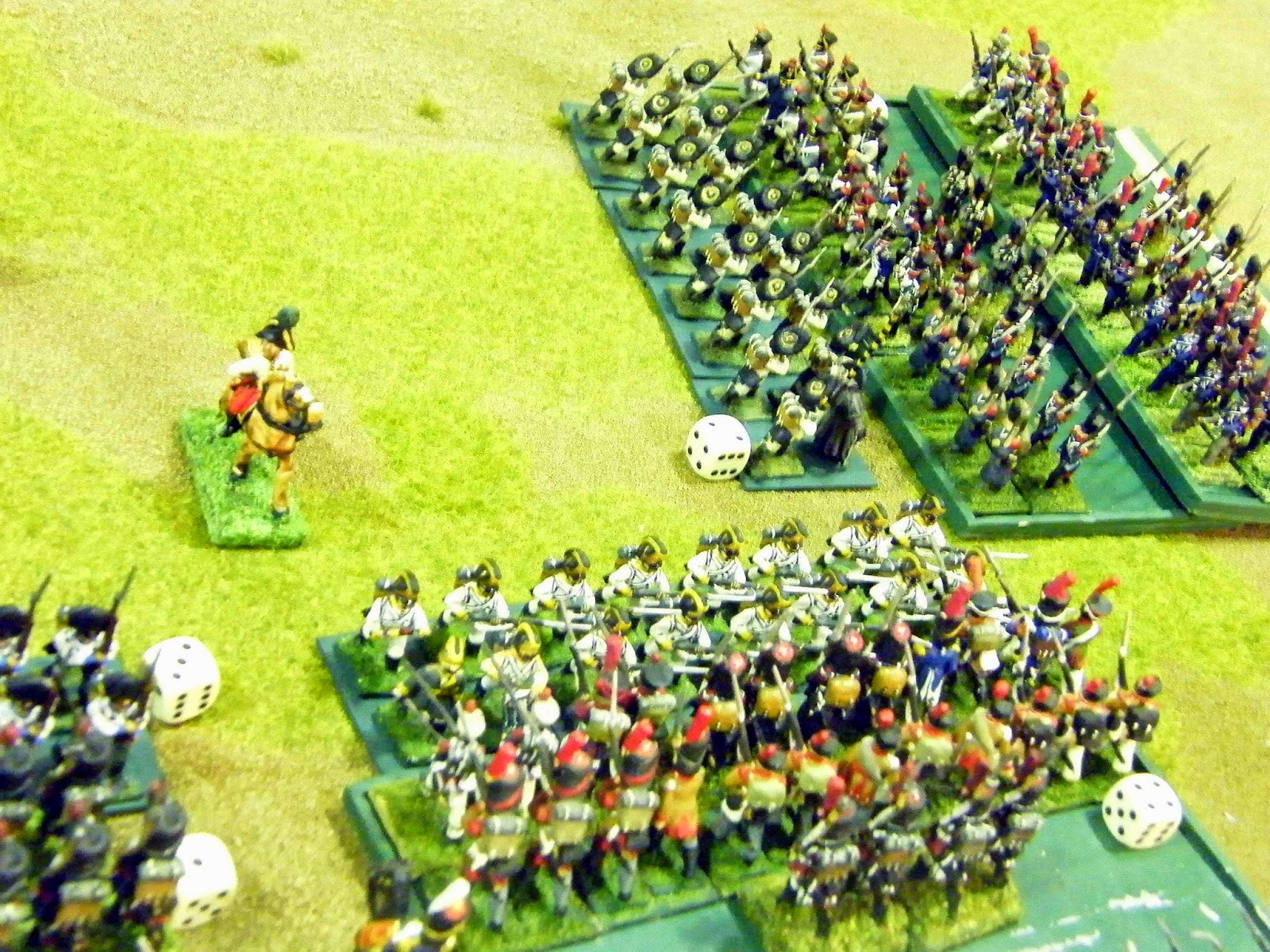
This campaign started off at the historical point of June 4 1807. On this date the Russo-Prussian forces started their offensive (one day early in the north due to a communication not reaching the Prussian commander in time). We have set the ratio of figures to troops for battles as 1 to 75 for infantry, 1 to 40 for cavalry and 1 gun to every 2 battalions or cavalry regiments fielded for a battle. We are using our modified WRG rule set (modified for simultaneous movement instead of alternate bound) to govern the battlefield games.
Prussian Lieutenant General Anton-Wilheim L'Estocq's Russo-Prussian Corps attacked first on the 4th June 1807 at Braunsberg and Spanden, both places held by the French I Corps.
The Prussian force numbered, 17,760 troops, when it attacked the French at Braunsberg (Maréchal Victor had 16,560 troops).
The attack was vigorous but resulted in a defeat for General L'Estocq with the loss of 6,995 men (1,475 captured) and Marshal Victor loosing 2,295 troops. The Prussian Corps retreated for two days to the town of Brandenburg.
Meanwhile the Russian component of L'Estocq's corps under the command of Major-General Kaminskoi (10,320 troops) attacked French General de Division Rivaud (2nd Division of I Corps plus the corps cavalry under Tilly-9,120 troops) at Spanden on the same day. This was a Russian victory, with the French loosing 3,130 troops (783 captured) and Kaminskoi loosing 3,325 troops. General Rivaud retreated to Muhlhausen on the Prussian Holland-Braunsberg road.
This allowed General Kaminskoi to advance to Prussian-Holland but this advance did not happen until he was ordered directly by Marshal Beningsen and was given the support of the Russian 6th Guard Division.
Meanwhile on the 5th June 1807, further south the Russians attacked at Lomitten. This attack was lead by Major-Général Ivan Semenovich Doctorov with 15,700 troops (loss of 700 troops) against French General de Division Legrand with his 3rd Division of Maréchal Soult's IV Corps and with General Guyot corps cavalry in support for a total of 12,030 troops. The result was a defeat for the French with the loss of 1,580 troops (395 captured). General Legrand withdrew to just beyond IV Corps position at Leibstadt. This placed Maréchal Ney's VI Corps at Guttstadt in a perilous position. The main Russian forces advanced from Heilsberg and Seefeld towards Guttstadt. Ney decided to withdraw and attempt to link up with Soult at Leibstadt.
Also on the 5th June General Maréchal Davout's III Corps (20,820 troops) was attacked by Major-General Bagration with 25,680 troops at Allenstein. Maréchal Davout was protecting the right flank of the French forces. Bagration's attacked faltered and was driven back to Passenheim for the loss of 4,905 (1,226 captured) to Davout's loss of 3,750.
In the centre the main Russian forces joined up at Guttstadt and followed a retreating Ney to Leibstadt. Marshal Beningsen decided to attack the combined French corps of Soult and Ney on the 7th June. Marshal Beningsen had under command 2nd Column-General Sacken , 4th Column-General Gortchakow and 1st Column-General Dochtorow for a total of 80,630 troops. Maréchal's Soult, Ney and Murat (he had joined them with the Reserve Cavalry) had 49,000 troops. The battle was a loss for the French with 2,735 (684 captured) troops lost against the Russian loss of 4,980 troops.
The French though only withdraw 4 miles to the village of Reichertswalde and turned to give battle again to the Russians. There were just 37,930 Russians enagaged against 56,375 French troops. Reichertswalde was a different matter as Napoleon, who was approaching Leibstadt from Georgenthal decided to march to the sound of the guns, leaving the road just 4 miles from Leibstadt (where the Russian 1st Column was waiting for him) and crossed the 2 miles to reach the right flank of the French position at Reichertswalde with his Imperial Guard and a division of Spanish (this force came from Italy and is not the La Romana division that went to garrison the Baltic coast). The battle resulted in a defeat for the Russians and more glory for Ney as his corps took the brunt of the Russian attack. The loss of 7,160 Russian troops (1,790 captured) against 5,200 French.
Even though the French were victorious at Reichertswalde the Russians had cut their supply line at Prussian-Holland. The IV and VI Corps plus the Reserve Cavalry had to retreat to reopen their supply line, the Imperial Guard and Spanish Division also withdraw to support these forces. Upon arrival at Prussian-Holland Napoleon sent IV Corps straight into the attack. Soult pressed home his attack on the Russian centre and left while the Imperial Guard moved against the Russian right. There were continuos Russian counter-attacks against Maréchal Soult and Murat. Maréchal Ney's VI Corps remained in reserve behind the Spanish Division. In the end the French were again victorious but the Imperial Guard and Spanish Division had to return to Leibstadt to clear their supply line of more Russian forces.
The Battle of Prussian-Holland involved 26,965 Russians (17,000 Imperial Guard) and their losses where 2,350 (588 captured) and there were 52,255 French (10,000 Imperial Guard) and they lost 3,860 troops. The French had a 2:1 advantage but it did take most the day for that advantage to take effect. Maréchal Ney's VI Corps and the Spanish cavalry did not arrive at all on the field of battle.
The Russian forces at Prussian-Holland retreated to Mehlsack (Imperial Guard 6th Column) and Guttstadt (Russian Div from the Prussian corps). Meanwhile Beningsen 2nd & 4th Columns moved towards Wormditt. The French I, IV, VI Corps plus some Reserve Cavalry advanced from Prussian-Holland through Spanden towards Mehlsack. The VI Corps stopped at Mehlsack to observe the Russian 6th Guard Column at Peterswalde where it had withdrawn too at the approach of the three French Corps.
In the northern sector the Prussian's advanced again (after calling in some reserve forces) towards Braunsberg. When General L'Estocq arrived opposite Braunsberg (12 June) he discovered that the French I Corps had moved south leaving the town unoccupied. General L'Estocq crossed the river and occupied Braunsberg, on the 13th June and ordered his sappers to remove the French defence works that faced east. A couple days later the French VIII Corps (Mortier-20,130) arrived from Elbing and attacked General L'Estocq (25,200) forcing him and his troops out of Braunsberg. The French VIII Corps lost 5,400 men and the Prussian's retreated to Gallou to rest and reform his shattered regiments.
On the same day as Braunsberg the Russian 7th Column attacked the Poles at Neigenburg. This Polish force was beaten and forced to retreat to Hohenstein. Next the 7th Column advanced towards Graudenz to relieve the Prussian garrison.
The French I and IV Corps plus some of the cavalry reserve under Murat (47,550) moved south from Mehlsack towards Wormditt. at the same time the Russian 2nd and 4th Columns (53,225) moved north towards Wormditt. These movements resulted in the two day battle (16-18 June) at Wormditt. which in the end was another French victory (loss 7,290) , forcing the Russians (loss 19,160 [4,190 captured]) to retreat towards Heilsberg. The French then moved from Wormditt. to Prussian-Eylau and cut the Russian 2nd & 4th Columns main supply line. The Russians had the intention of not stopping at Heilsberg after Wormditt and continue to Eylau, so the French did not force a retreat on the Russians from Heilsberg as they had hoped but brought the Russians to Eylau earlier that the French would have expected them if the Russians had stopped at Heilsberg.
On the 22nd June the Russian 7th Column attacked the French forces at Graudenz. The attacked was unsuccessful and the Russians withdraw, leaving General Royuer to continue his blockade of Graudenz.
On this same day the Battle of Prussian-Eylau started with the French I & IV Corps being attacked by the Russian 2nd and 4th Columns. This was a hard fought action but the French had to withdraw a few miles when the Russian Army of Moravia arrived from the east which exposed the French left flank and rear. The Russians moved forward and went into the attack again on the 23rd June.
The second day was every bit has hard fought as the first day. In the end even with the Reserve Cavalry and Imperial Guard the battle drew to a close with no clear victor. Napoleon ordered a withdrawal down the two approach roads (to Wormditt. and to Heilsberg) so his corps could rest and refit. Some reserve regiments were moving from Elbing to join Napoleon.
The last action of the campaign (as it turned out) was the Battle of Heiligenbeil fought on the 28th June 1807 with the British Expeditionary Force (30,840) of Lt General William Schaw, Lord Cathcart (this force had landed at Pillau) and the Prussian Corps of Lieutenant General Anton-Wilheim L'Estocq (25,200) for a total of 56,040 against the French VIII Corps of Maréchal Adolphe Mortier (17,315), the Spanish El norte de la División of General Pedro Caro y Sureda, Marques de la Romana (15,360) and the Dutch Korps of General van Kattendijke (15,480) for a total of 48,155.
The Anglo-Prussian forces attacked the Franco-Spanish-Dutch forces in a most vigorous manner. The Anglo-Prussian commanders knew they had to beat the French and force them to withdraw or else the French would be in a position to invest Konigsberg within a few days and that would be the end for the remaining Prussian forces and probably the embarkation of the British Force and the Russians suing for peace.
The Anglo-Prussian's concentrated their attack against the Spanish and all but destroyed the El norte de la División (losses of 11,565). But casualties were not light for the VIII Corps (losses 8,255) and the Dutch Korps (losses 6,245) for a total loss of 26,065. The British lost 10,150 and the Prussian's 5,665 for a total of 15,815. Such losses speak of the desperate nature of the combat for both sides. The French had to retreat beyond Braunsberg to Elbing (a main French supply hub) where there was another two French Divisions as well as two divisions at Prussian Holland which could be called to resist and Anglo-Prussian attack on Elbing.
The Anglo-Prussian advance against Elbing now threatened all the French forces. Napoleon faced allied forces behind his left and right flanks and with the Russian Army of Moravia having joined the Russian 1st Army of Poland plus the arrival of a rebel Austrian Corps at Prussian Eylau to the Emperors' front Bonaparte decided to ask for peace with the allies which meant the loss of the newly created Duchy of Warzaw but only East Prussia and Prussian Poland free of the French. As for the British, their forces went on to attack Copenhagen and destroy the Danish fleet.
This war is over, for now.